
Intro
The blowout taper is two haircuts shaking hands. On top: length, lift, and air — hair blow-dried upward and outward until it has real height and movement. Around the edges: a taper, kept local and deliberate, cleaning up the temples, sideburns, and neckline without shaving the sides down to nothing. The result is the rare cut that looks both effortless and intentional: big on top, sharp at the borders.
It has become one of the most requested men’s cuts of 2026 for a simple reason — it photographs well and wears well. The volume gives the face presence; the taper keeps the whole thing from sliding into shaggy. And unlike trend cuts that only work on one hair type, the blowout taper adapts: curls get a rounder silhouette, straight hair gets a sleeker lift, thick hair gets shape instead of bulk.
One thing to get straight before the chair: tell your barber you want the volume, not the fringe. A lot of what the internet calls a “blowout taper” is really a fringe-first cut with tapered sides — and this site already covers that version in the low taper fade fringe guide. This guide is about the other, cleaner animal: the blow-dried top with real height, finished with a proper taper. If you walk in asking for volume and walk out with a fringe, the cut failed at the consultation, not the scissors.
This guide covers 15 blowout taper styles for men, the low-vs-mid-vs-high taper decision, a home styling routine that actually works, and the exact script to use at the barber.
Quick Answer — Key Takeaways
- A blowout taper = a voluminous blow-dried top + a localized taper at the temples, sideburns, and neckline. Two parts, one haircut.
- It is not a blowout fade: a taper leaves visible hair and blends gradually; a fade drops to skin. The taper is the softer, more grow-out-friendly choice.
- The volume comes from technique, not just length — blow-drying upward from the roots with a round brush, plus lightweight mousse or sea salt spray. Product alone will not do it.
- Taper height sets the attitude: low is softest and most conservative, mid is the most requested balance, high is the boldest contrast.
- Fine or thinning hair can wear a restrained version (style 15); very long, heavy tops need regular trims or the volume collapses under its own weight.
What Is a Blowout Taper?
Break the name into its two halves and the cut explains itself.
The blowout half is all about the top: hair left long enough to lift — usually 3 to 6 inches — then styled with heat and airflow so it stands away from the head with height, separation, and outward movement. “Blowout” here means the styling method as much as the look: the volume is built with a blow-dryer, not just wished into existence with product. Done right, the top looks airy and touchable rather than stiff or helmet-like.
The taper half is the cleanup crew. A taper gradually shortens hair around the temples, sideburns, and neckline, blending down without the hard skin line of a fade. It is localized — the sides above the taper keep meaningful length, which is what lets the voluminous top flow into the sides instead of sitting on top of shaved walls. That transition is the whole elegance of the cut.
Why the name causes confusion at the barber: one barber hears “taper” and pictures a soft, classic temple cleanup; another hears it and reaches for fade guards. And one client says “blowout” meaning big loose volume while another means a sleek swept-back finish. A reference photo resolves all of it in five seconds — bring one, always.
Low vs Mid vs High Taper: The Comparison
The taper’s height is the single biggest lever on how the cut reads. Same top, three different attitudes:
| Low taper | Mid taper | High taper | |
|---|---|---|---|
| Blend placement | Sits just above the ears and at the nape | Starts around the middle of the sides | Rises well up the sides, near the crown line |
| Contrast with the top | Softest — the top flows into the sides | Balanced — clear but not dramatic separation | Boldest — the volume pops against short sides |
| Side coverage | Most — keeps the sides full | Moderate | Least — sides stay tight |
| Grow-out | Most forgiving, stretches 4–5 weeks | Standard 3–4 week rhythm | Shows growth fastest, needs 2–3 week touch-ups |
| Best for | Conservative workplaces, first-timers, rounder faces that want balance | Most men — the default recommendation | Strong jawlines, thick hair, men who want the volume to be the whole statement |
If you are unsure, start low or mid. A taper can always be taken higher at the next appointment; it cannot be un-cut.
Who Suits a Blowout Taper?
This is one of the more democratic men’s cuts. Straight hair gets the sleekest version of the lift; wavy hair gets natural movement for free; curly and coily hair get a rounded, sculptural silhouette that looks intentional instead of accidental. Thick hair — the usual problem child — finally gets a cut that removes bulk at the edges while celebrating volume on top.
Face shape guidance is mostly about where you put the height. Oblong and long faces should keep the volume controlled and let the taper do more of the work, or the head reads even longer. Round faces benefit from genuine height on top, which elongates. Square faces can go either way — the cut’s clean edges echo a strong jawline nicely.
The honest limits: very fine or thinning hair cannot support a big airy top — the lift exposes scalp instead of creating shape (style 15 covers the restrained version that does work). And anyone unwilling to spend five minutes with a blow-dryer should know the truth: without heat and airflow, this cut dries into a flat, grown-out-looking top. The dryer is not optional; it is half the haircut.
15 Best Blowout Taper Styles for Men
1. Classic Blowout Taper

The reference version: a full, airy top with real lift, sides kept at a natural length, and a soft taper cleaning up the temples and neckline. Nothing extreme, everything balanced — this is the photo to show when you want “the blowout taper” with no qualifiers. Who it suits: most hair types, most face shapes, most workplaces. Maintenance: low-medium (taper tidy every 4 weeks, top trim every 5–6). Styling tip: the classic lives or dies on the roots — dry them upward first, and the rest of the top follows.
2. Low Taper Blowout
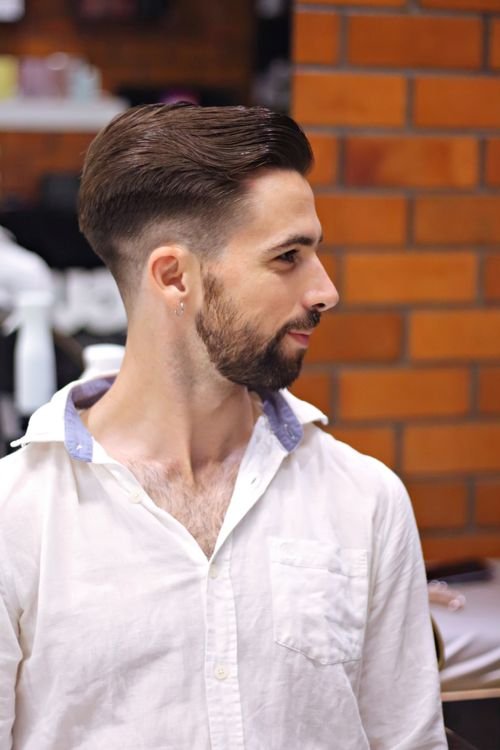
The softest taper of the set, hugging just above the ears and nape while the top stays big and loose. From most angles it reads as a full head of voluminous hair with quietly perfect edges — the taper is felt more than seen. Who it suits: conservative offices, first-timers, men growing out a shorter cut. Maintenance: low (the most forgiving grow-out of the taper heights). Styling tip: because the sides stay fuller, keep the top’s volume forward and up rather than wide, or the silhouette gets round.
3. Mid Taper Blowout

The default recommendation and the most requested version: the taper starts mid-side, giving clean definition without drama, while the top keeps its full blow-dried height. It is the best ratio of sharp to wearable in the whole guide. Who it suits: genuinely most men — thick, wavy, or straight hair; square, oval, and heart faces. Maintenance: medium (taper refresh every 3–4 weeks). Styling tip: ask the barber to blend the taper up into the top’s length rather than disconnecting it — a disconnected mid taper turns the top into a cap.
4. High Taper Blowout

Maximum contrast: the taper climbs high up the sides, so the voluminous top detonates against tight, clean sides. This is the boldest version — closer to a statement cut, and the one that photographs most dramatically. Who it suits: thick hair, strong jawlines, men who want the volume to be unmistakable. Maintenance: medium-high (the high taper shows growth fastest — every 2–3 weeks). Styling tip: with this much contrast, the top must be genuinely voluminous; a flat top over a high taper just looks like a grown-out fade.
5. Curly Blowout Taper

Curls plus a blowout sounds like a contradiction until you see it: the top is dried with a diffuser to encourage the curl pattern while lifting the roots, and the taper sculpts the edges so the curls read as a deliberate rounded shape. The result keeps all of curl’s character with none of the triangle-head. Who it suits: curly to coily hair, medium to thick density. Maintenance: medium (curls hide taper grow-out well; top needs shaping every 5–6 weeks). Styling tip: diffuser on low heat, roots first, and a light curl cream — heavy product plus heat equals crunch, not volume.
6. Wavy Blowout Taper

Wavy hair is the blowout taper’s easiest customer: the natural bend gives the top movement with barely any coaxing, and the dryer just amplifies what is already there. The taper keeps the waves from turning into a shapeless mass at the edges. Who it suits: natural wavy hair, medium density and up. Maintenance: low-medium. Styling tip: sea salt spray on damp hair, then blow-dry with your fingers instead of a brush — the brush can pull waves too straight and kill the texture that makes this version good.
7. Straight and Refined Blowout Taper

Volume without texture: the top is blow-dried smooth with a round brush for a polished lift, and the taper is crisp and precise. This is the boardroom version — all the height, none of the mess. Who it suits: straight hair, professional settings, men who like grooming to look deliberate. Maintenance: medium (the sleek finish shows taper grow-out sooner). Styling tip: a vented round brush and a nozzle on the dryer are what separate “refined” from “puffy” — airflow direction matters more than product here.
8. Textured and Messy Blowout

The lived-in version: the top gets the full blowout lift, then the texture is roughed up with matte paste for separated, piecey movement. It keeps the volume but drops the formality — weekend energy with weekday bones. Who it suits: straight to wavy hair, younger wearers, anyone whose style leans casual. Maintenance: low-medium. Styling tip: build the volume first with the dryer, add the mess second with product — reversing the order gives you sticky flatness instead of airy texture.
9. Sleek Swept-Back Blowout

The top flows up and back in one continuous movement, with the taper holding the sides tight so the silhouette stays aerodynamic. Think classic leading-man hair with a modern edge — volume with direction. Who it suits: medium-length tops, straight to wavy hair, prominent foreheads it flatters by design. Maintenance: medium. Styling tip: dry the top backward in sections with a round brush, then lock it with a light matte clay — strong-hold gel turns this into a 2012 throwback, so keep the finish soft.
10. Longer-Top Wild Blowout

For men committed to length: the top runs 5–6 inches and gets the full blowout treatment for maximum height and outward movement, while the taper keeps the whole thing anchored. It is the most dramatic version — unmissable, high-maintenance, and worth it if you want the cut to be your signature. Who it suits: thick hair that can support the weight, confident wearers, creative fields. Maintenance: high (long tops collapse without regular trims and daily drying). Styling tip: work in layers — dry the under-sections first for the foundation lift, then the surface for the finish. One pass never lifts a long top properly.
11. Short and Minimal Blowout

Proof the cut does not need length to work: a shorter top (2–3 inches) gets a quick upward blow-dry for lift, and a neat taper does the rest. The everyday version — five minutes, honest volume, zero drama. Who it suits: busy men, athletes, anyone who wants the idea of the cut without the styling commitment. Maintenance: low. Styling tip: on short tops the dryer does 80% of the work — two minutes of upward airflow beats any amount of product.
12. Blowout Taper with Beard

The contrast pick: a big airy top, a clean taper, and a full beard to anchor the lower half of the face. The beard’s density balances the top’s volume so neither half overwhelms the other — it is one of the most flattering combinations in this guide. Who it suits: men who can grow a full beard, longer and rounder faces that benefit from the vertical balance. Maintenance: medium-high (two zones to maintain). Styling tip: keep the taper and the beard’s cheek line in conversation — if the taper is high and tight, the beard’s top edge should be equally crisp or the face looks divided. (See also: beard fading detail.)
13. Cowlick-Aware Blowout
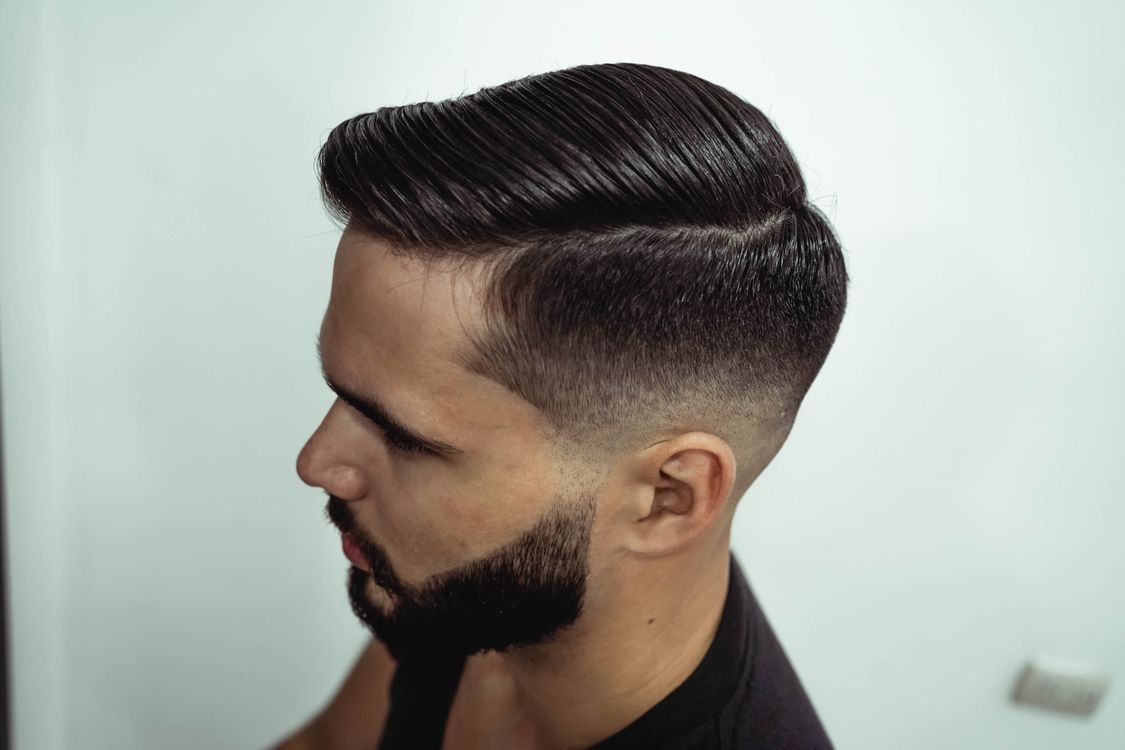
The problem-solver version: for men whose hair grows in competing directions at the crown or hairline, the blowout is built around the cowlick instead of fighting it — extra length where the swirl lives, dryer direction matched to the growth pattern, and a taper that keeps the surrounding edges obedient. Who it suits: anyone with a stubborn crown swirl or hairline cowlick. Maintenance: medium. Styling tip: dry the cowlick area FIRST while it is wettest — once a cowlick sets dry, no product on earth moves it. This is the section most competitors skip; it is here because real heads have swirls.
14. Blowout Taper for Thick Hair

Thick hair’s dilemma is bulk: too much of it and the top becomes a heavy cap instead of an airy blowout. The fix is internal — point-cutting and layering to remove weight while keeping length — plus a taper that takes the sides down decisively so the top has somewhere to go. Who it suits: genuinely thick, dense hair. Maintenance: medium (thick hair grows fast and the shape goes). Styling tip: ask specifically for weight removal, not just shortening — a thick top cut blunt will never blow out properly no matter how good your dryer technique is.
15. Blowout Taper for Fine or Thinning Hair

The honest version: a big airy top is off the table for fine hair — lift exposes scalp — so this keeps the top moderate, the texture piecey, and the taper soft and low. A light volumizing powder at the roots gives the suggestion of fullness without the see-through risk. Who it suits: fine hair, early thinning at the crown. Maintenance: low-medium. Styling tip: matte powder beats mousse here — mousse clumps fine hair into separated strands that show scalp; powder thickens the look of each strand. And keep the top no longer than 3 inches, or gravity wins.
How to Style a Blowout Taper at Home
The dryer is half the haircut, so here is the routine that actually builds the volume:
- Start damp, not wet — towel-dry until the hair is moist but not dripping. Sopping hair takes forever and the roots set flat while you wait.
- Heat protectant first, always. You are about to aim hot air at your hairline daily; protect it.
- Work a golf-ball of lightweight mousse (or a few sprays of sea salt spray) through the top, roots to ends. Keep heavy creams and oils away from this step — they kill lift.
- Blow-dry the roots upward first, in sections, with a round or vented brush lifting as you go. The roots set the direction; everything else follows.
- Once the roots are dry and lifted, dry the lengths outward and up for the airy finish. Cool-shot button at the end to lock the shape.
- Finish with a pea of matte clay or paste, warmed between palms, worked through the mid-lengths — not the roots, which would collapse the lift you just built.
Total time once practiced: five to eight minutes. Refresh on day two with dry shampoo at the roots instead of re-washing.
What to Tell Your Barber (The Script)
Say this, in this order: “I want a blowout taper — volume on top, taper on the sides. Keep [3–6] inches on top, blow-dried with lift. Taper the temples, sideburns, and neckline — [low/mid/high], blended, not a skin fade. Point-cut the top for texture so it moves.”
Then show the reference photo. The photo resolves what words cannot: how high the taper sits, how big the top is, whether the finish is sleek or messy. Barbers consistently say the photo matters more than the name — two clients saying “blowout taper” can mean two different haircuts, but one photo ends the debate.
Two things to forbid explicitly: do not let the taper become a skin fade unless you asked for the high-contrast version (a fade changes the cut’s whole character), and do not let the top get a blunt straight-across cut — the blowout needs point-cut texture to move.
Maintenance: How Often to Trim
The taper and the top run on different clocks. The taper shows growth first — every 2–3 weeks for high tapers, 3–4 for mid, 4–5 for low. The top needs a reshape every 4–6 weeks, or the length starts collapsing the volume it is supposed to create. Between cuts, avoid heavy oils and waxes near the roots; they drag the lift down. A weekly clarifying wash keeps product buildup from flattening everything.
Blowout Taper vs Blowout Fade vs Regular Taper
Three names, three different contracts with your barber. A blowout taper pairs the big top with a taper — gradual shortening, visible hair left at the edges, soft grow-out. A blowout fade pairs the same top with a fade — the sides drop to skin, the contrast is sharper, and the maintenance clock runs faster. A regular taper is just the edge cleanup with no blowout top at all — neat borders on an otherwise ordinary cut. If you want the volume to be the star with forgiving upkeep, the taper is the right partner; if you want maximum drama and do not mind the chair every two weeks, the fade is.
FAQ
Is a blowout taper the same as a blowout fade?
No. The taper leaves visible hair and blends gradually at the temples, sideburns, and neckline; the fade drops to skin. The taper grows out more gracefully and needs less frequent touch-ups.
How is it different from a regular taper haircut?
A regular taper is only the edge work. The blowout taper adds the voluminous blow-dried top — without the top, it is not a blowout taper.
Can thin or fine hair wear a blowout taper?
A restrained version, yes — see style 15. Keep the top moderate, use volumizing powder instead of mousse, and skip the big airy versions, which expose scalp on fine hair.
How often does the taper need trimming?
High tapers every 2–3 weeks, mid every 3–4, low every 4–5. The top needs reshaping every 4–6 weeks regardless.
Does it suit round faces?
Yes, with real height on top — the vertical lift elongates the face. Keep the sides neat rather than wide.
Do I really need a blow-dryer?
Yes. Without heat and upward airflow, the top dries flat and the cut reads as a grown-out regular haircut. The dryer is not optional equipment here.
Conclusion
The blowout taper earns its 2026 popularity honestly: it is a cut with a clear structure — volume built with technique on top, discipline at the edges — that adapts to more hair types than most trend cuts dare. Pick your taper height from the comparison table, learn the five-minute dryer routine, and bring the photo. And if what you actually want is the fringe falling over the forehead, that version already lives here: the low taper fade fringe guide covers the fringe-forward take, while this one stays volume-first. Two articles, two different haircuts, no confusion.
